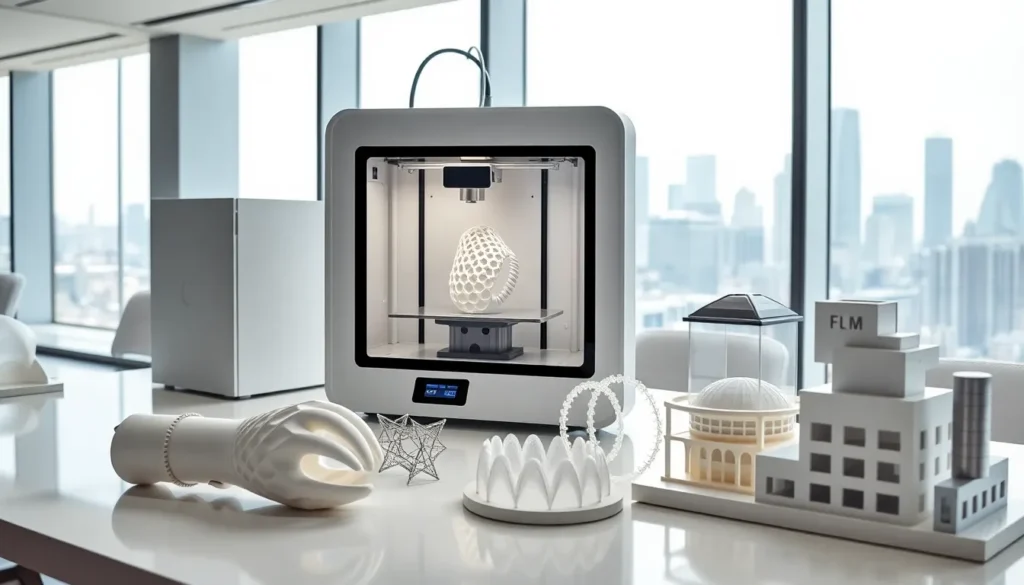

3D printing examples now span nearly every major industry, from life-saving medical devices to custom fashion accessories. This technology builds objects layer by layer from digital files, and it has moved far beyond prototyping into full-scale production. Companies use 3D printing to cut costs, speed up manufacturing, and create designs that traditional methods cannot achieve.
The global 3D printing market reached over $18 billion in 2023 and continues to grow rapidly. Businesses large and small adopt this technology because it offers flexibility, reduces waste, and enables on-demand production. This article explores real-world 3D printing examples across six key sectors, showing how additive manufacturing reshapes modern industry.
Table of Contents
ToggleKey Takeaways
- 3D printing examples now span healthcare, aerospace, automotive, consumer products, construction, and education—proving the technology has moved far beyond simple prototyping.
- Healthcare applications include custom prosthetics for under $50, patient-specific surgical models, and millions of dental aligners produced annually.
- Aerospace giants like GE Aviation and SpaceX use 3D printing to create lighter, stronger parts that outperform traditionally manufactured components.
- Consumer brands such as Adidas offer mass customization through 3D-printed shoe midsoles with lattice structures impossible to make using traditional methods.
- Construction companies can now 3D print entire homes in under 24 hours, using less material and labor while meeting building codes.
- Educational institutions use 3D printing examples to teach hands-on engineering and design skills that prepare students for careers across multiple industries.
Healthcare and Medical Applications
Healthcare stands out as one of the most impactful areas for 3D printing examples. Surgeons now use patient-specific anatomical models to plan complex operations. These models help doctors visualize tumors, bone structures, and blood vessels before making a single incision.
Custom prosthetics represent another breakthrough. Traditional prosthetic limbs cost thousands of dollars and require weeks of fitting. 3D printing reduces both cost and production time significantly. Organizations like e-NABLE provide free 3D-printed prosthetic hands to children worldwide, often for under $50 in materials.
Dental applications have embraced 3D printing at scale. Orthodontists produce clear aligners, crowns, and surgical guides directly in their offices. Companies like Align Technology print millions of custom aligners each year using this approach.
Bioprinting pushes the boundaries further. Researchers at Wake Forest Institute for Regenerative Medicine have 3D printed skin grafts for burn victims. Scientists also work on printing functional organs, though this technology remains in early stages. The FDA has already approved several 3D-printed medical devices, including spinal implants and hearing aids.
3D printing examples in healthcare save lives and reduce costs simultaneously. Hospitals report shorter surgery times and better outcomes when using printed surgical guides and models.
Aerospace and Automotive Manufacturing
Aerospace companies lead the adoption of industrial 3D printing examples. GE Aviation produces fuel nozzles for jet engines using metal 3D printing. Each nozzle previously required welding 20 separate parts together. Now, GE prints it as a single piece that weighs 25% less and lasts five times longer.
SpaceX uses 3D printing extensively in rocket production. The company prints SuperDraco engine chambers from a nickel-based superalloy. This process takes a fraction of the time compared to traditional manufacturing.
Boeing installs over 70,000 3D-printed parts across its aircraft fleet. These components include air ducts, brackets, and interior cabin parts. Lighter parts mean better fuel efficiency, which translates to significant cost savings over an aircraft’s lifetime.
Automotive manufacturers also rely on 3D printing examples throughout their operations. BMW prints custom jigs and fixtures for its assembly lines. Bugatti created 3D-printed titanium brake calipers that weigh 40% less than conventional versions.
Prototyping remains a core use case. Engineers can test multiple design iterations in days rather than months. Ford prints prototype parts overnight, accelerating its development cycles considerably.
3D printing examples in aerospace and automotive demonstrate how additive manufacturing handles high-performance materials while meeting strict safety standards. The technology proves especially valuable for low-volume, high-complexity parts.
Consumer Products and Fashion
Consumer goods companies use 3D printing examples to offer mass customization at reasonable prices. Adidas sells running shoes with 3D-printed midsoles through its 4DFWD line. The lattice structure provides specific cushioning properties impossible to achieve with traditional foam.
Eyewear brands like Safilo print custom-fit glasses based on facial scans. Customers receive frames shaped precisely for their features. This approach reduces returns and increases satisfaction.
Jewelry designers embrace 3D printing for intricate pieces. Complex geometric patterns and interlocking designs come from printers rather than traditional casting. Designers upload files, and production facilities print pieces in precious metals directly.
Fashion designers experiment with 3D-printed garments and accessories. Iris van Herpen has showcased elaborate 3D-printed dresses at major fashion weeks. While these remain more art than everyday wear, the technology influences mainstream design.
Home goods companies print custom furniture components and decorative items. Customers select colors, patterns, and sizes through online configurators. The products ship directly from printing facilities.
These 3D printing examples show how personalization scales effectively. Brands differentiate themselves by offering products that fit individual preferences without maintaining massive inventories.
Architecture and Construction
Construction represents one of the most ambitious frontiers for 3D printing examples. Companies now print entire buildings using large-scale concrete printers. ICON, a Texas-based company, has printed homes in under 24 hours. These structures use less material and labor than traditional construction.
The first permitted 3D-printed home in the United States was built in 2021 in Austin, Texas. The 400-square-foot structure demonstrated that printed buildings meet local building codes. Since then, ICON has completed larger projects, including a planned community of 100 3D-printed homes.
Architects use 3D printing for detailed scale models. Complex facades and organic shapes translate directly from software to physical form. This process speeds up client presentations and design reviews.
Dubai set ambitious targets for 3D printing in construction. The city aims to have 25% of its new buildings constructed using 3D printing technology by 2030. The Dubai Future Foundation offices became one of the first fully functional 3D-printed office buildings.
3D printing examples in construction address labor shortages and housing affordability. The technology uses less concrete than traditional methods, reducing environmental impact. Curved walls and custom shapes cost the same as straight walls, opening new design possibilities.
Education and Research
Schools and universities use 3D printing examples to teach design thinking and engineering principles. Students create physical objects from their digital designs, reinforcing concepts through hands-on experience.
Engineering programs incorporate 3D printing into core curricula. Students design, print, and test mechanical components. They learn iteration quickly because printing a new version takes hours, not weeks.
Science classrooms benefit from printed models of molecules, organs, and geological formations. Teachers bring abstract concepts into physical form. A student can hold a protein structure or examine a cross-section of a heart.
Research laboratories depend on 3D printing for custom equipment. Scientists print specialized holders, mounts, and enclosures for experiments. A researcher can design a part in the morning and use it that afternoon.
Paleontologists print replicas of rare fossils for study and display. Museums create touchable copies of fragile artifacts. Visitors experience objects they could never handle in original form.
3D printing examples in education demonstrate practical skills alongside theoretical knowledge. Students graduate with experience in a technology they will encounter in nearly every industry.