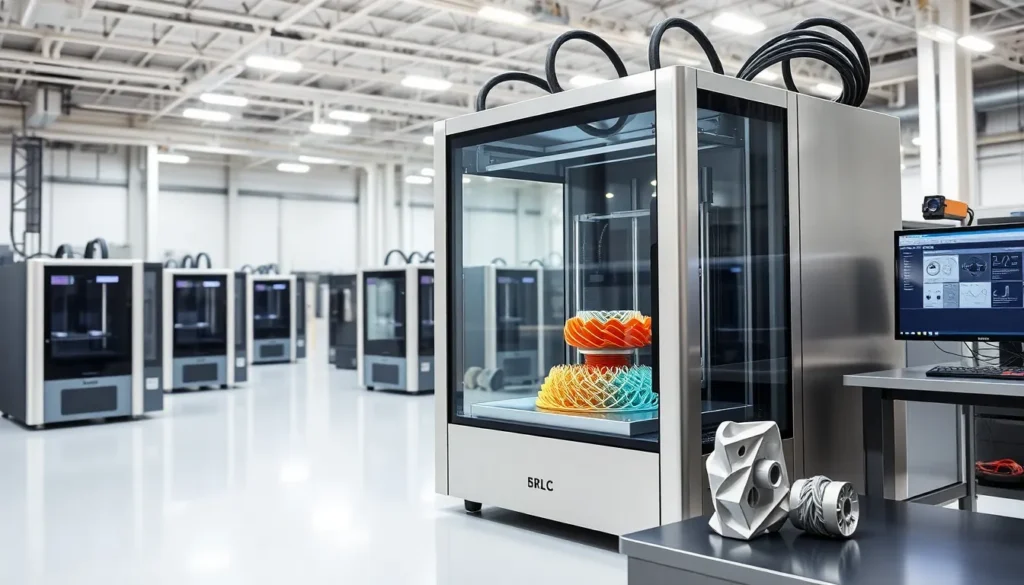

The 3D printing trends 2026 landscape promises significant shifts across industries, materials, and applications. Manufacturers, healthcare providers, and designers are preparing for a year of faster machines, smarter software, and greener processes. This article breaks down the key 3D printing trends 2026 will bring, from multi-material capabilities to AI-powered workflows. Whether you’re a business owner, engineer, or hobbyist, these developments will shape how products get made. Here’s what’s coming and why it matters.
Table of Contents
ToggleKey Takeaways
- 3D printing trends 2026 will feature multi-material and full-color printing, allowing manufacturers to produce finished products—not just prototypes—in a single build.
- AI-driven design tools will automate print optimization, reduce material waste, and lower the skill barrier for achieving high-quality results.
- Sustainable materials like biodegradable filaments and recycled feedstocks are becoming mainstream, with some operations achieving 90% material recovery rates.
- Healthcare applications are expanding rapidly, including custom implants, same-day dental restorations, and affordable 3D-printed prosthetics.
- New technologies are boosting production speeds by 25 to 100 times, making industrial-scale 3D printing viable for automotive, aerospace, and medium-volume manufacturing.
- By late 2026, the 3D printing trends reshaping the industry will make additive manufacturing competitive with traditional methods for jobs that seemed impractical just two years earlier.
Advances in Multi-Material and Full-Color Printing
One of the most exciting 3D printing trends 2026 will showcase is the rise of multi-material and full-color printing. Until recently, most printers handled one material at a time. That’s changing fast.
New printer models now combine plastics, metals, and flexible materials in a single build. This capability allows manufacturers to create finished products, not just prototypes, straight from the machine. Think of a shoe sole with rigid support structures and soft cushioning printed together. Or an electronic housing with conductive pathways built right in.
Full-color printing is also maturing. Earlier systems produced limited color ranges or required post-processing. The latest machines use advanced inkjet technology to deposit color during the print itself. Designers can now produce vibrant, detailed models without painting or finishing steps.
For businesses, this means shorter production cycles. Parts that once required assembly from multiple components can now emerge as single units. The 3D printing trends 2026 brings will make multi-material work accessible to mid-sized companies, not just large corporations with R&D budgets.
Consumer applications are growing too. Custom figurines, architectural models, and personalized products benefit from these advances. As prices drop and reliability improves, expect multi-material printing to become standard rather than specialized.
AI-Driven Design and Print Optimization
Artificial intelligence is reshaping how people design for 3D printing. Among the 3D printing trends 2026 will accelerate, AI integration stands out for its practical impact.
Traditional design requires significant expertise. Engineers must understand material properties, support structures, and machine limitations. AI tools now handle much of this work automatically. Upload a basic concept, and the software suggests optimal geometries, reduces material waste, and predicts potential print failures.
Generative design takes this further. Users input performance requirements, load capacity, weight limits, mounting points, and AI produces multiple design options. These algorithms often create organic-looking structures that humans wouldn’t conceive but perform better than conventional shapes.
Print optimization is equally important. AI monitors prints in real-time, adjusting temperatures, speeds, and layer heights to prevent defects. Some systems use cameras and sensors to detect problems mid-print and correct them automatically. This reduces failed prints and wasted materials.
The 3D printing trends 2026 introduces will make AI assistance available through cloud platforms. Small businesses and individual makers can access enterprise-grade optimization without expensive hardware. This democratization matters because it lowers the skill barrier for quality output.
Expect AI-driven tools to become as common as slicing software is today. They won’t replace human creativity but will amplify what’s possible with less trial and error.
Sustainable Materials and Eco-Friendly Practices
Sustainability is driving major 3D printing trends 2026 will highlight. The industry is responding to environmental concerns with new materials and cleaner processes.
Biodegradable filaments are gaining ground. PLA (polylactic acid) has been around for years, but newer options include algae-based plastics, recycled ocean plastics, and agricultural waste composites. These materials perform well and break down responsibly at end-of-life.
Recycled feedstocks are becoming mainstream. Several companies now offer closed-loop systems where failed prints and support materials get ground up and re-extruded into fresh filament. This cuts waste dramatically. Some industrial operations report 90% material recovery rates.
Energy efficiency is improving too. Newer machines use optimized heating systems and smarter power management. Cold-printing technologies, which cure materials with UV light rather than heat, consume significantly less electricity than traditional methods.
The 3D printing trends 2026 showcases will also include carbon footprint tracking. Software now calculates emissions per print, helping businesses meet sustainability targets and report accurately to stakeholders.
Manufacturers are paying attention because customers demand it. A 2024 survey found 67% of buyers prefer products made with sustainable methods. 3D printing’s ability to produce locally, eliminating shipping emissions, adds another environmental advantage.
Green practices aren’t just good ethics. They’re becoming competitive requirements.
Growth in Medical and Healthcare Applications
Healthcare represents one of the fastest-growing areas in 3D printing trends 2026 will bring forward. Hospitals, dental clinics, and medical device companies are adopting the technology at rapid pace.
Custom implants lead the charge. Surgeons now use patient-specific titanium implants printed from CT scan data. These fit better than standard sizes, reduce surgery time, and improve outcomes. Hip replacements, cranial plates, and spinal cages are already in regular use.
Dental applications have exploded. Aligners, crowns, bridges, and surgical guides come off printers daily in thousands of practices worldwide. The 3D printing trends 2026 will expand into same-day dentures and more complex restorations.
Bioprinting continues advancing. Researchers print living tissue structures using cell-laden bio-inks. While full organ printing remains years away, skin grafts, cartilage, and tissue models for drug testing are reaching clinical stages.
Prosthetics have transformed too. 3D-printed prosthetic limbs cost a fraction of traditional versions and can be customized for each user. Children, who outgrow prosthetics quickly, benefit enormously from affordable, replaceable options.
Regulatory pathways are clearing. The FDA has approved hundreds of 3D-printed medical devices, and approval processes are becoming faster and more standardized. This regulatory clarity encourages investment and innovation.
The 3D printing trends 2026 presents in healthcare will save lives and reduce costs. Personalized medicine is no longer a distant promise, it’s happening now.
Faster Production Speeds and Industrial Scalability
Speed has always been 3D printing’s weakness for mass production. The 3D printing trends 2026 will deliver are changing that equation.
New technologies dramatically cut print times. Continuous liquid interface production (CLIP) and high-speed sintering methods produce parts in minutes rather than hours. Some systems now achieve speeds 25 to 100 times faster than conventional FDM printers.
Larger build volumes allow bigger parts or more items per batch. Industrial machines with meter-scale build chambers are entering the market. Manufacturers can print car panels, furniture, or dozens of smaller components simultaneously.
Automation is making production lines possible. Robots remove finished prints, load new build plates, and keep machines running continuously. This 24/7 capability changes the economics of additive manufacturing.
The 3D printing trends 2026 highlights also include better quality at speed. Faster doesn’t mean sloppier anymore. Improved lasers, nozzles, and control systems maintain precision even at accelerated rates.
For industries like automotive and aerospace, these advances matter enormously. Ford, BMW, and Airbus already use 3D printing for production parts, not just prototypes. As speeds increase, more components become viable for additive manufacturing.
Small manufacturers benefit too. Print farms, rooms full of synchronized machines, can compete with injection molding for medium-volume runs. The break-even point between traditional and additive manufacturing keeps shifting in 3D printing’s favor.
By late 2026, expect industrial 3D printing to handle jobs that seemed impractical just two years earlier.