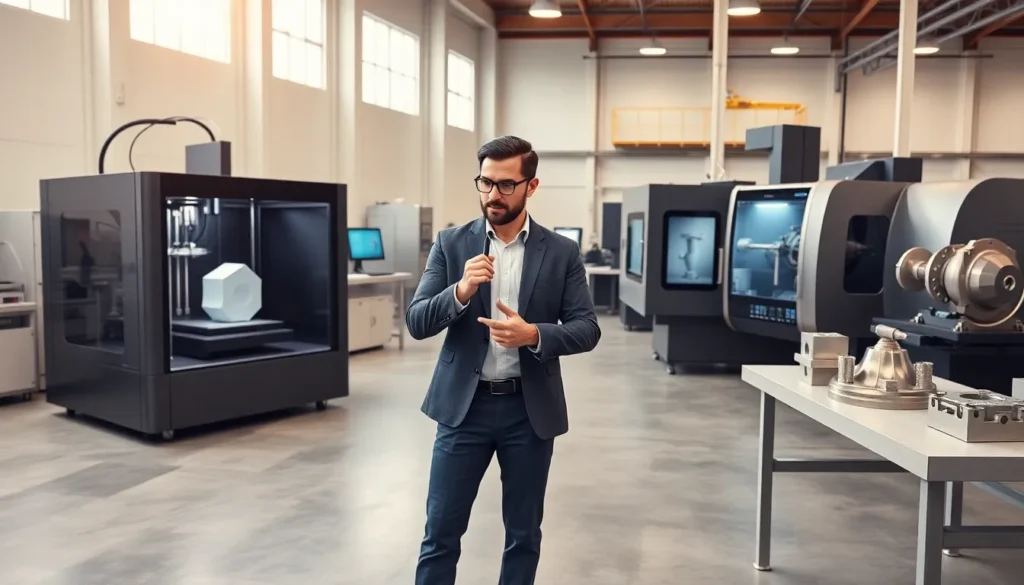

3D printing vs traditional manufacturing represents one of the most important decisions modern businesses face. Each method offers distinct advantages depending on project requirements, budget constraints, and production goals. 3D printing builds objects layer by layer from digital files. Traditional manufacturing uses methods like injection molding, CNC machining, and casting to shape raw materials. This comparison breaks down the key differences in cost, speed, materials, and ideal use cases. By the end, readers will know which approach fits their specific needs.
Table of Contents
ToggleKey Takeaways
- 3D printing vs traditional manufacturing comes down to flexibility versus scale—additive methods excel at prototyping and small batches, while traditional methods dominate high-volume production.
- 3D printing requires no tooling and can produce prototypes in 2–24 hours, making it ideal for rapid design iteration.
- Traditional manufacturing becomes more cost-effective than 3D printing when production volumes exceed 100–500 units due to lower per-unit costs.
- Material quality in traditional manufacturing generally offers superior strength and consistency, though 3D printing continues to close the gap, especially in metal applications.
- Many businesses use a hybrid approach—prototyping with 3D printing, then transitioning to injection molding or CNC machining for volume production.
- Choose 3D printing for custom parts, complex geometries, and fast turnarounds; choose traditional methods when per-unit cost, tight tolerances, and material strength are priorities.
How 3D Printing Works Compared to Traditional Methods
3D printing, also called additive manufacturing, creates objects by depositing material layer by layer. A digital 3D model guides the printer. The machine reads the file and builds the part from the bottom up. Common 3D printing technologies include Fused Deposition Modeling (FDM), Stereolithography (SLA), and Selective Laser Sintering (SLS).
Traditional manufacturing takes a different approach. Methods like injection molding require custom molds that shape molten material. CNC machining cuts away material from a solid block to form the final part. Casting pours liquid material into molds and lets it solidify.
The fundamental difference comes down to additive vs subtractive processes. 3D printing adds material only where needed. Traditional methods often remove material or require expensive tooling upfront.
Setup also differs significantly. 3D printing needs only a digital file to begin production. Traditional manufacturing requires molds, dies, or custom tooling, processes that can take weeks. This makes 3D printing vs traditional methods a question of flexibility versus scale.
For prototyping, 3D printing wins on speed and simplicity. Designers can print a test part in hours, evaluate it, and print a revised version the same day. Traditional prototyping often requires multiple steps and specialized equipment.
Cost Differences Between 3D Printing and Conventional Manufacturing
Cost structures differ dramatically between 3D printing and conventional manufacturing. Understanding these differences helps businesses allocate budgets effectively.
3D printing has low startup costs. No molds or tooling are required. Material costs scale linearly with part size and complexity. A single prototype might cost $20–$200 depending on size and material. This makes 3D printing vs injection molding an easy choice for small batches.
Traditional manufacturing requires significant upfront investment. A single injection mold can cost $5,000–$100,000 or more. But, once the mold exists, per-unit costs drop dramatically. Producing 10,000 identical parts through injection molding costs pennies per piece.
Here’s the cost crossover point: 3D printing typically becomes more expensive than traditional methods when production volumes exceed 100–500 units, depending on part complexity and material.
Cost comparison at different volumes:
| Volume | 3D Printing | Injection Molding |
|---|---|---|
| 1–10 units | Most economical | Expensive (tooling costs) |
| 50–100 units | Competitive | Approaching break-even |
| 500+ units | Expensive per unit | Most economical |
Labor costs also factor in. 3D printing requires minimal operator intervention. Traditional manufacturing often needs skilled machinists and quality control personnel. The 3D printing vs traditional manufacturing cost debate eventually depends on production scale.
Speed and Production Volume Considerations
Speed and volume requirements often determine which manufacturing method makes sense. Both 3D printing and traditional methods excel in different scenarios.
3D printing offers fast turnaround for small quantities. A prototype can go from digital design to physical part in 2–24 hours. No tooling delays. No minimum order quantities. This speed advantage makes 3D printing vs conventional methods ideal for rapid iteration.
But, 3D printing has limitations at scale. Most printers produce one part at a time, though some can batch smaller components. Print times range from hours to days for larger parts. Scaling up means adding more printers, a linear cost increase.
Traditional manufacturing flips this equation. Initial setup takes weeks or months. But once production starts, output accelerates rapidly. An injection molding machine can produce thousands of identical parts per day. CNC machines run continuously with minimal supervision.
For product development timelines:
- 3D printing: Days from concept to prototype
- Traditional manufacturing: Weeks to months for tooling, then rapid production
Businesses launching new products often use both methods. They prototype with 3D printing, validate designs, then transition to traditional manufacturing for volume production. This hybrid approach captures the strengths of each method.
The 3D printing vs traditional manufacturing speed comparison favors additive methods for agility and subtractive methods for throughput.
Material Options and Quality Comparisons
Material selection affects part performance, durability, and cost. Both 3D printing and traditional manufacturing offer broad material options, though with different trade-offs.
3D printing materials include:
- Plastics: PLA, ABS, PETG, Nylon
- Resins: Standard, flexible, high-detail
- Metals: Stainless steel, titanium, aluminum (via SLS or DMLS)
- Specialty materials: Carbon fiber composites, ceramics, food-safe options
Traditional manufacturing supports nearly any material that can be molded, machined, or cast. This includes engineering-grade plastics, all metal alloys, glass, and advanced composites.
Quality differences exist but continue to narrow. Traditional manufacturing generally produces stronger parts with consistent material properties. Injection-molded plastics have uniform density. CNC-machined metals meet tight tolerances.
3D printed parts can show layer lines and anisotropic properties, meaning strength varies depending on print orientation. Post-processing like sanding, vapor smoothing, or heat treatment can improve surface finish and strength.
For functional parts under stress, traditional manufacturing often delivers superior results. For visual prototypes, custom geometries, or low-stress applications, 3D printing vs traditional methods becomes more competitive.
Metal 3D printing has advanced significantly. Aerospace and medical industries now use additive manufacturing for production parts. These applications demand strict quality control and testing protocols.
When to Choose Each Manufacturing Method
Choosing between 3D printing vs traditional manufacturing depends on specific project requirements. Here are clear guidelines for each approach.
Choose 3D printing when:
- Producing fewer than 100 units
- Prototyping and iterating designs quickly
- Creating custom or one-off parts
- Building complex geometries impossible with traditional methods
- Testing market response before investing in tooling
- Needing parts within days, not weeks
Choose traditional manufacturing when:
- Producing 500+ identical units
- Requiring maximum material strength and consistency
- Working with materials not available for 3D printing
- Per-unit cost matters more than setup time
- Tight tolerances and surface finishes are critical
Some industries blend both methods effectively. Medical device companies print patient-specific implants while mass-producing standard components through injection molding. Automotive manufacturers print jigs, fixtures, and prototypes while stamping and molding production parts.
The 3D printing vs traditional manufacturing decision isn’t always binary. Many businesses maintain both capabilities. They print prototypes, short-run parts, and replacement components in-house. They outsource high-volume production to traditional manufacturers.
Project timeline, budget, quantity, and quality requirements all influence the final choice. Understanding each method’s strengths leads to better manufacturing decisions.