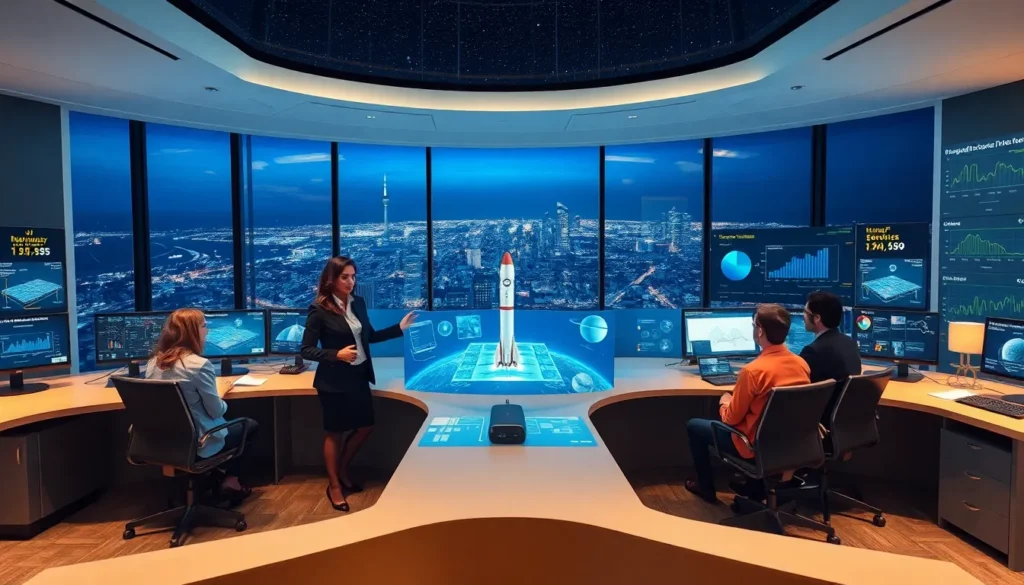

Space technology ideas are driving some of the most exciting breakthroughs in human history. From reusable rockets to orbital factories, engineers and scientists are rethinking how we explore and use space. These innovations aren’t just cool concepts, they’re actively reshaping industries, economies, and our understanding of what’s possible beyond Earth’s atmosphere.
The pace of development has accelerated dramatically. Private companies now compete alongside national agencies. Costs are dropping. Ambitions are growing. What once seemed like science fiction is becoming engineering reality. This article explores five space technology ideas that stand to transform exploration, energy production, and manufacturing in the coming decades.
Table of Contents
ToggleKey Takeaways
- Reusable rockets like SpaceX’s Falcon 9 have slashed launch costs by tens of millions of dollars per flight, making space access more economical and sustainable.
- Space-based solar power could deliver gigawatts of clean, continuous energy by capturing sunlight 99% of the time without atmospheric interference.
- Orbital debris removal is becoming critical as space junk threatens satellites, with companies like Astroscale and ClearSpace developing capture and cleanup technologies.
- Advanced propulsion systems, including ion engines and nuclear thermal rockets, will dramatically reduce travel times for deep space missions.
- In-space manufacturing and resource utilization represent transformative space technology ideas that could reduce Earth dependence and unlock trillion-dollar asteroid mining opportunities.
Reusable Rocket Systems and Sustainable Launch Solutions
Reusable rockets have fundamentally changed the economics of space access. Traditional rockets were single-use vehicles, essentially billion-dollar machines thrown away after one flight. That model made space expensive and wasteful.
SpaceX’s Falcon 9 proved reusability works. The company has now landed boosters over 300 times. Each successful landing saves tens of millions of dollars. Blue Origin and Rocket Lab are pursuing similar approaches with their own systems.
These space technology ideas extend beyond simple cost savings. Reusable rockets reduce manufacturing demand, which cuts resource consumption. They also enable faster turnaround times between launches. A rocket that lands on Monday can theoretically fly again within weeks.
The environmental implications matter too. Fewer rockets built means less industrial waste. Some companies are exploring methane-based fuels that produce cleaner exhaust. Others are testing electric pump systems to improve efficiency.
Starship represents the next evolution. SpaceX designed this fully reusable system to carry 100+ tons to orbit. If successful, it could drop launch costs below $100 per kilogram, a figure that would unlock entirely new categories of space missions.
Space-Based Solar Power Generation
Space-based solar power captures energy where the sun always shines. Unlike ground-based panels, orbital collectors face no clouds, no nighttime, and no atmospheric absorption. A satellite in geostationary orbit receives sunlight roughly 99% of the time.
The concept isn’t new, scientists proposed it in the 1960s. But recent advances in wireless power transmission and lightweight materials have made it practical. Several countries now have active research programs.
China announced plans for a megawatt-class demonstration by 2035. Japan’s JAXA has tested microwave transmission systems. The European Space Agency launched its SOLARIS initiative to assess feasibility. These space technology ideas could eventually supply clean energy to entire continents.
The engineering challenges remain significant. Satellites would need to be enormous, some designs span kilometers. Transmitting power to Earth via microwave or laser requires precise targeting. Ground receivers would cover substantial land areas.
Still, the potential output is staggering. A single large space solar station could generate gigawatts of continuous power. That’s enough to supply millions of homes with zero carbon emissions during operation. As launch costs fall, the economics improve steadily.
Orbital Debris Removal Technologies
Space junk threatens every satellite and spacecraft in orbit. Decades of launches have left thousands of defunct satellites, rocket stages, and fragments circling Earth. Each piece travels at roughly 28,000 kilometers per hour. At those speeds, even a paint fleck can damage critical systems.
The problem is getting worse. Collisions create more debris, which causes more collisions, a cascade known as Kessler Syndrome. Some orbital bands already show dangerous congestion levels.
Several space technology ideas target this growing hazard. Astroscale, a Japanese company, demonstrated magnetic capture in 2021. Their ELSA-d mission successfully approached and grappled a target satellite. ClearSpace, working with ESA, plans to remove a rocket fragment in 2026.
Other approaches include nets, harpoons, and robotic arms. Some researchers propose lasers that slow debris until it falls into the atmosphere. Others suggest deploying drag sails that accelerate natural decay.
The business case is becoming clearer. Insurance companies want cleaner orbits. Satellite operators need safer operating environments. Governments recognize the strategic importance of protecting space infrastructure. Active debris removal may soon become standard practice rather than experimental technology.
Advanced Propulsion Systems for Deep Space Travel
Chemical rockets work well for reaching orbit but struggle with interplanetary distances. The fuel requirements grow exponentially as mission duration increases. Reaching Mars takes months. Reaching the outer planets takes years.
Advanced propulsion systems aim to solve this limitation. Ion engines produce low thrust but operate for months or years continuously. NASA’s Dawn mission used ion propulsion to visit two asteroids. The technology is mature and increasingly common on commercial satellites.
Nuclear propulsion offers another path forward. Nuclear thermal rockets heat propellant directly, achieving roughly twice the efficiency of chemical engines. NASA and DARPA are jointly developing the DRACO demonstration project, targeting a 2027 test flight.
More exotic space technology ideas include solar sails, which use photon pressure for propulsion. The Planetary Society’s LightSail 2 proved the concept works. Japan’s IKAROS flew to Venus using only sunlight for thrust.
Fusion propulsion remains further out but would be transformative. A working fusion drive could cut Mars transit times to weeks rather than months. Several private companies claim progress, though significant technical hurdles remain.
These propulsion advances matter because speed equals capability. Faster travel means healthier astronauts, fresher supplies, and more ambitious destinations.
In-Space Manufacturing and Resource Utilization
Manufacturing in space eliminates gravity’s constraints. Certain materials form more uniformly in microgravity. Crystals grow larger. Fiber optics achieve higher purity. Biological tissues develop without the distortions caused by their own weight.
Several companies already produce goods aboard the International Space Station. Varda Space Industries launched its first orbital factory in 2023. They focus on pharmaceutical compounds that benefit from microgravity processing.
In-situ resource utilization (ISRU) takes space technology ideas a step further. Rather than launching everything from Earth, future missions will extract and process materials found at their destinations. The Moon contains water ice, metals, and oxygen-rich minerals. Asteroids hold platinum-group metals worth trillions.
NASA’s MOXIE experiment on Mars demonstrated oxygen extraction from the atmosphere. Future Mars missions could produce their own propellant, dramatically reducing launch mass requirements from Earth.
The vision extends to full orbital industry. Space stations could manufacture satellites on-site instead of launching finished products. Lunar bases could produce construction materials from regolith. Asteroid mining could supply raw materials without depleting Earth’s reserves.
These capabilities compound over time. Each step reduces Earth dependence and enables the next level of expansion.