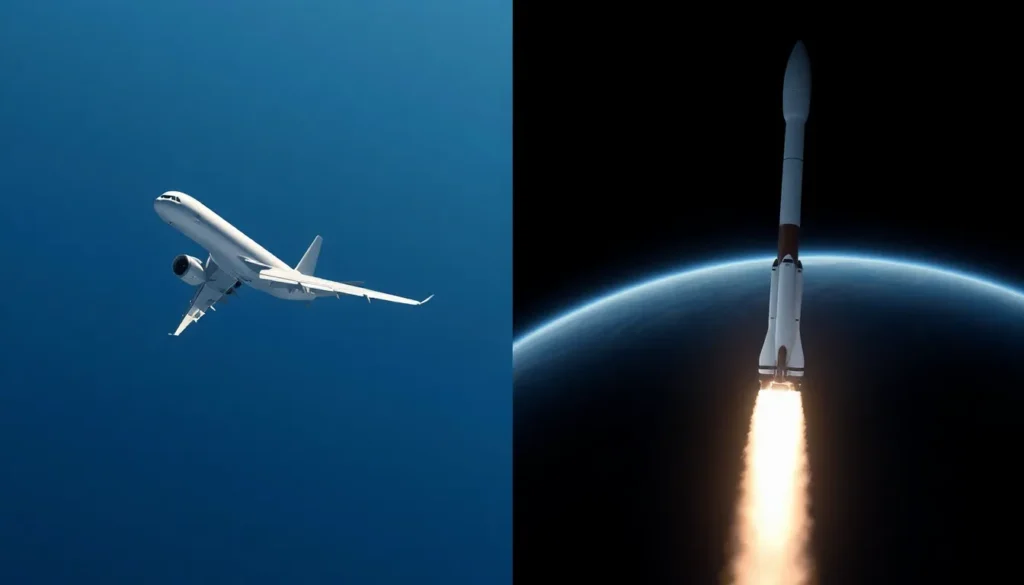

Space technology vs traditional aerospace represents one of the most significant shifts in modern engineering and exploration. While both fields share common roots, they’ve diverged in fascinating ways over the past few decades. Traditional aerospace focuses on aircraft operating within Earth’s atmosphere. Space technology pushes beyond, sending satellites, rockets, and probes into orbit and beyond.
This distinction matters more than ever. Private companies now launch rockets weekly. Satellites provide internet to remote villages. Mars missions capture public imagination. Understanding how space technology differs from traditional aerospace helps explain where billions in investment dollars flow, and why.
The differences span propulsion systems, materials science, commercial applications, and cost structures. Each field solves different problems with different constraints. Let’s break down what separates these two branches of aerospace engineering and explore how innovations in space technology are reshaping the industry.
Table of Contents
ToggleKey Takeaways
- Space technology vs traditional aerospace differs primarily in operational environment—aircraft work within Earth’s atmosphere while spacecraft operate in the vacuum of space beyond the 100-kilometer Kármán line.
- Propulsion systems represent the clearest divide: aircraft use jet engines requiring atmospheric oxygen, while rockets carry both fuel and oxidizer for space operation.
- Space technology has become dramatically more accessible, with SpaceX’s reusable rockets cutting launch costs by roughly 80% compared to previous generations.
- Commercial applications have diverged significantly—traditional aerospace moves billions of passengers annually, while space technology generates over $130 billion through satellite communications alone.
- Future innovations like hypersonic vehicles and point-to-point space travel will increasingly blur the boundaries between space technology and traditional aerospace.
Defining Space Technology and Traditional Aerospace
Traditional aerospace covers the design, development, and production of aircraft, helicopters, and missiles. These vehicles operate within Earth’s atmosphere, typically below 100 kilometers altitude. Companies like Boeing, Airbus, and Lockheed Martin have dominated this sector for decades. Their focus: building machines that work with air resistance, generate lift, and transport people or cargo across continents.
Space technology operates differently. It involves spacecraft, satellites, rockets, and systems designed to function in the vacuum of space. The Kármán line at 100 kilometers marks the conventional boundary. Above this point, aerodynamic lift becomes irrelevant. Vehicles must rely entirely on thrust and orbital mechanics.
The space technology sector has exploded in recent years. SpaceX, Blue Origin, and Rocket Lab have joined legacy players like NASA and ESA. These organizations build launch vehicles, space stations, and deep-space probes. They also develop ground systems, tracking networks, and mission control infrastructure.
Key distinctions emerge in operational environments. Aircraft face air pressure, temperature variations, and weather. Spacecraft face vacuum, extreme radiation, and temperature swings from -250°F to 250°F within minutes. These different challenges require fundamentally different engineering approaches.
Space technology also involves longer mission timelines. A commercial flight lasts hours. A satellite mission might last 15 years. This changes everything from component selection to quality testing procedures.
Core Technological Differences
Propulsion systems mark the clearest technological divide between space technology and traditional aerospace. Aircraft use jet engines or turboprops that require atmospheric oxygen for combustion. Rockets carry both fuel and oxidizer, enabling operation in space where no air exists.
Space technology employs several propulsion types. Chemical rockets dominate launch vehicles. Ion thrusters power deep-space missions. Newer concepts include nuclear thermal propulsion and solar sails. Traditional aerospace remains largely tied to turbofan and turboprop configurations, though electric aircraft are emerging.
Materials and Thermal Protection
Material requirements differ dramatically. Aircraft use aluminum alloys, titanium, and carbon composites designed for strength-to-weight ratios and fatigue resistance. Space technology demands materials that withstand vacuum outgassing, radiation degradation, and extreme thermal cycling.
Heat shields illustrate this difference well. Spacecraft re-entering Earth’s atmosphere face temperatures exceeding 3,000°F. Traditional aerospace materials would fail instantly. Space technology uses ablative heat shields, reinforced carbon-carbon, and specialized ceramic tiles.
Communication and Navigation
Aircraft rely on radar, GPS, and radio communication with ground stations. Space technology requires different solutions. Signals take 20 minutes to reach Mars. Deep-space missions use the Deep Space Network. Satellites in geostationary orbit sit 22,236 miles from Earth, requiring high-gain antennas and precise pointing.
Autonomy levels also differ. Aircraft have pilots making real-time decisions. Spacecraft often operate autonomously for extended periods. A Mars rover can’t wait for instructions from Earth. Space technology hence requires more sophisticated onboard computing and decision-making capability.
Commercial Applications and Industry Impact
Traditional aerospace generates revenue through commercial aviation, defense contracts, and general aviation. Airlines purchase aircraft costing $100 million to $450 million each. Defense ministries buy fighters, transports, and helicopters. The industry employs millions worldwide and moves billions of passengers annually.
Space technology has carved out distinct commercial markets. Satellite communications generate over $130 billion annually. GPS-enabled services touch nearly every smartphone user. Earth observation satellites support agriculture, weather forecasting, and environmental monitoring.
The launch services market has transformed in the past decade. SpaceX’s reusable rockets cut launch costs by roughly 80%. This opened doors for smaller companies to deploy satellites. Constellations like Starlink now provide broadband internet using thousands of spacecraft.
Manufacturing and Supply Chains
Traditional aerospace relies on established supply chains developed over a century. Tier-one suppliers feed components to final assembly lines. Production rates for commercial aircraft reach about 50 units monthly for popular models.
Space technology manufacturing operates differently. Production volumes are lower but increasing. SpaceX produces Falcon 9 rockets at rates unseen in the industry. Satellite manufacturing has shifted toward mass production for mega-constellations. This mirrors traditional aerospace’s high-volume approach.
Both industries now share technologies. Advanced composites developed for aircraft appear in spacecraft structures. Additive manufacturing (3D printing) serves both sectors. Software systems originally built for space missions now appear in commercial aircraft avionics.
Cost, Accessibility, and Future Outlook
Cost structures differ substantially between space technology and traditional aerospace. A new commercial aircraft costs $80 million to $400 million. Development programs run $10 billion to $50 billion. Airlines spread these costs across decades of service and millions of passengers.
Space technology traditionally meant astronomical expenses. The Space Shuttle program cost roughly $1.5 billion per launch. Today’s landscape looks different. Falcon 9 launches cost approximately $67 million. Small satellite launchers offer rides for under $10 million. This cost reduction has democratized access to space.
Accessibility has improved in both sectors. Traditional aerospace now includes urban air mobility concepts and electric vertical takeoff aircraft. Space technology welcomes commercial astronauts and plans space tourism operations. Blue Origin and Virgin Galactic have already flown paying customers.
Investment and Growth Trends
Private investment flows heavily into space technology. Venture capital funding exceeded $10 billion annually in recent years. Traditional aerospace attracts investment too, but the growth rate in space technology outpaces it significantly.
Future developments will blur lines between these sectors. Hypersonic vehicles operate in both regimes. Point-to-point space travel could compete with long-haul aviation. Companies like SpaceX propose using rockets for intercontinental transport, completing trips in under an hour.
Traditional aerospace faces pressure to decarbonize. Electric and hydrogen-powered aircraft remain years away from widespread adoption. Space technology focuses on reusability and cost efficiency. Both industries will likely share more technologies and talent as boundaries continue shifting.