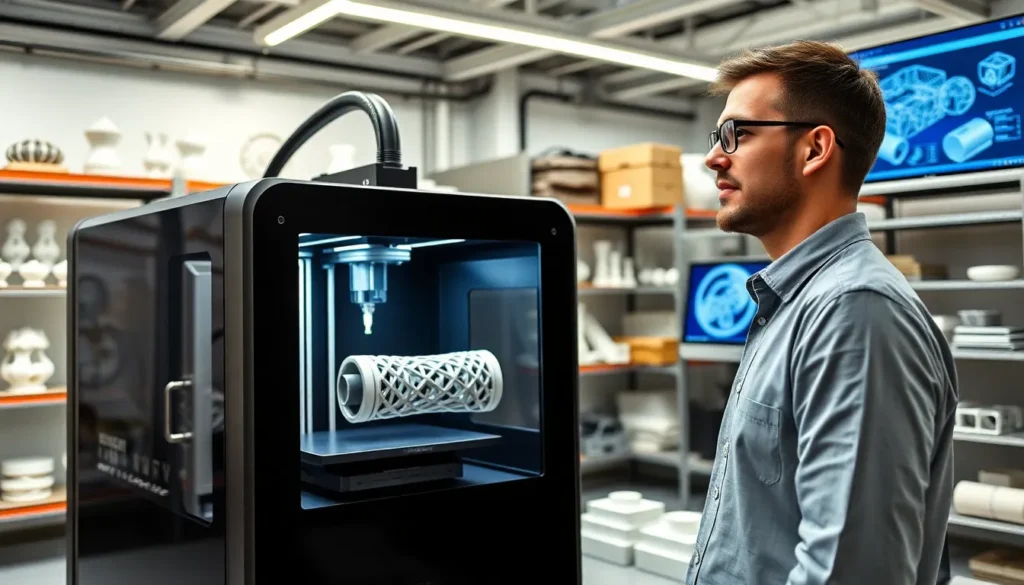

Top 3D printing has moved far beyond hobbyist workshops. In 2025, the technology powers everything from aerospace components to custom medical implants. The global 3D printing market is projected to exceed $50 billion by 2026, and the surge shows no signs of slowing.
What’s driving this growth? Faster printers, stronger materials, and software that makes complex designs accessible to small businesses and major manufacturers alike. Whether someone is prototyping a new product or producing end-use parts at scale, 3D printing offers speed and flexibility that traditional manufacturing can’t match.
This guide breaks down the leading technologies, most popular materials, and key applications shaping 3D printing today. It also covers how to choose the right solution based on specific needs and budget.
Table of Contents
ToggleKey Takeaways
- Top 3D printing technologies in 2025 include FDM, SLA, SLS, MJF, and DMLS—each suited for different applications from prototyping to metal part production.
- PLA, ABS, PETG, nylon, resins, and metals are the most popular materials, with selection depending on strength, heat resistance, and end-use requirements.
- Aerospace, medical, automotive, and consumer products industries are driving rapid growth in the 3D printing market, projected to exceed $50 billion by 2026.
- Choosing the right 3D printing solution requires defining your application, matching material properties to requirements, and evaluating volume needs.
- Always test sample parts from different services before investing in equipment to compare quality, accuracy, and real-world performance.
Leading 3D Printing Technologies
Several 3D printing technologies dominate the market in 2025. Each serves different purposes, and understanding them helps buyers make smarter decisions.
Fused Deposition Modeling (FDM)
FDM remains the most widely used 3D printing technology. It works by heating thermoplastic filament and extruding it layer by layer. FDM printers are affordable, easy to operate, and ideal for prototyping and functional parts. Many desktop printers use this method, making it accessible for home users and small businesses.
Stereolithography (SLA)
SLA uses a UV laser to cure liquid resin into solid layers. This process produces parts with exceptional surface finish and fine detail. Jewelry designers, dental labs, and product developers favor SLA for its precision. The trade-off? Resin materials can be more expensive, and post-processing requires additional steps.
Selective Laser Sintering (SLS)
SLS fuses powdered materials, typically nylon, using a high-powered laser. The powder bed supports the part during printing, eliminating the need for support structures. This makes SLS excellent for complex geometries and functional prototypes. Industrial manufacturers rely on SLS for durable, production-ready components.
Multi Jet Fusion (MJF)
HP’s Multi Jet Fusion technology has gained traction for its speed and consistency. MJF uses inkjet arrays to apply fusing agents to powder layers, then heats the material to bond particles together. It produces strong, detailed parts faster than many competing methods. Companies producing mid-volume runs often choose MJF for its balance of quality and efficiency.
Direct Metal Laser Sintering (DMLS)
DMLS enables top 3D printing in metals like titanium, stainless steel, and aluminum. A laser melts metal powder layer by layer to create dense, fully functional parts. Aerospace and medical industries use DMLS to manufacture lightweight brackets, surgical tools, and custom implants.
Most Popular 3D Printing Materials
The right material determines a part’s strength, flexibility, appearance, and cost. Here’s what’s trending in top 3D printing materials for 2025.
PLA (Polylactic Acid)
PLA is biodegradable, easy to print, and affordable. It’s the go-to choice for beginners and works well for visual prototypes, models, and educational projects. But, PLA has limited heat resistance and isn’t suitable for high-stress applications.
ABS (Acrylonitrile Butadiene Styrene)
ABS offers better durability and heat resistance than PLA. Manufacturers use it for functional prototypes and end-use parts. ABS requires a heated print bed and proper ventilation due to fumes during printing.
PETG (Polyethylene Terephthalate Glycol)
PETG combines the ease of PLA with improved strength and chemical resistance. It’s food-safe in many formulations and works well for containers, mechanical parts, and outdoor applications.
Nylon
Nylon delivers excellent strength, flexibility, and wear resistance. SLS and MJF printers commonly use nylon powders for functional prototypes and production parts. Its durability makes it popular in automotive and industrial settings.
Resins
Photopolymer resins come in dozens of formulations, standard, tough, flexible, castable, and dental-grade. SLA and DLP printers use resins to achieve smooth surfaces and precise details. Specialty resins now simulate the properties of ABS, rubber, and even ceramic.
Metals
Titanium, stainless steel, aluminum, and cobalt-chrome power top 3D printing applications in aerospace, medical, and tooling industries. Metal 3D printing costs more but enables geometries impossible with traditional machining.
Key Applications Driving 3D Printing Growth
3D printing has found a home across nearly every industry. These applications show where the technology delivers the most value.
Prototyping and Product Development
Rapid prototyping remains the most common use case. Designers can print a concept, test it, and iterate within days instead of weeks. This speed cuts development costs and helps products reach market faster.
Aerospace and Defense
Aerospace companies use 3D printing to produce lightweight brackets, fuel nozzles, and structural components. Printed parts often weigh less than machined alternatives while maintaining strength. Boeing, Airbus, and SpaceX all incorporate 3D printed components in their aircraft and rockets.
Medical and Dental
Custom implants, surgical guides, and dental aligners represent a fast-growing segment. 3D printing allows patient-specific solutions that fit better and improve outcomes. Hospitals now print anatomical models for pre-surgical planning, reducing operating time and risk.
Automotive
Car manufacturers use top 3D printing for prototyping, tooling, and even end-use parts. BMW, Ford, and Porsche print custom jigs, fixtures, and interior components. Electric vehicle startups leverage the technology to accelerate development cycles.
Consumer Products and Fashion
Eyewear, footwear, and jewelry brands embrace 3D printing for mass customization. Adidas and New Balance produce midsoles with lattice structures that would be impossible to mold traditionally. Custom-fit products command premium prices and build brand loyalty.
How to Choose the Right 3D Printing Solution
Selecting the right 3D printing technology and material depends on several factors. Here’s a practical framework.
Define the Application
Start with the end goal. Visual prototypes need good surface finish but not necessarily strength. Functional parts require durability and dimensional accuracy. Production runs demand consistency and cost efficiency.
Consider Material Requirements
Does the part need to withstand heat, chemicals, or mechanical stress? Will it be used indoors or outdoors? Matching material properties to application requirements prevents failures down the line.
Evaluate Volume and Speed
One-off prototypes suit desktop FDM or SLA printers. Mid-volume production may justify investing in SLS or MJF equipment, or outsourcing to a service bureau. High-volume manufacturing might still favor injection molding, though 3D printing closes the gap every year.
Budget for Total Cost
Printer price is just the start. Factor in materials, post-processing equipment, maintenance, and labor. Some technologies like SLA require washing and curing stations. Metal printing demands specialized safety equipment and expertise.
Test Before Committing
Order sample parts from different services before purchasing equipment. Compare surface quality, dimensional accuracy, and material performance. Real-world testing beats spec sheets every time.
Top 3D printing solutions match technology to need. There’s no universal best option, only the right fit for a specific project.