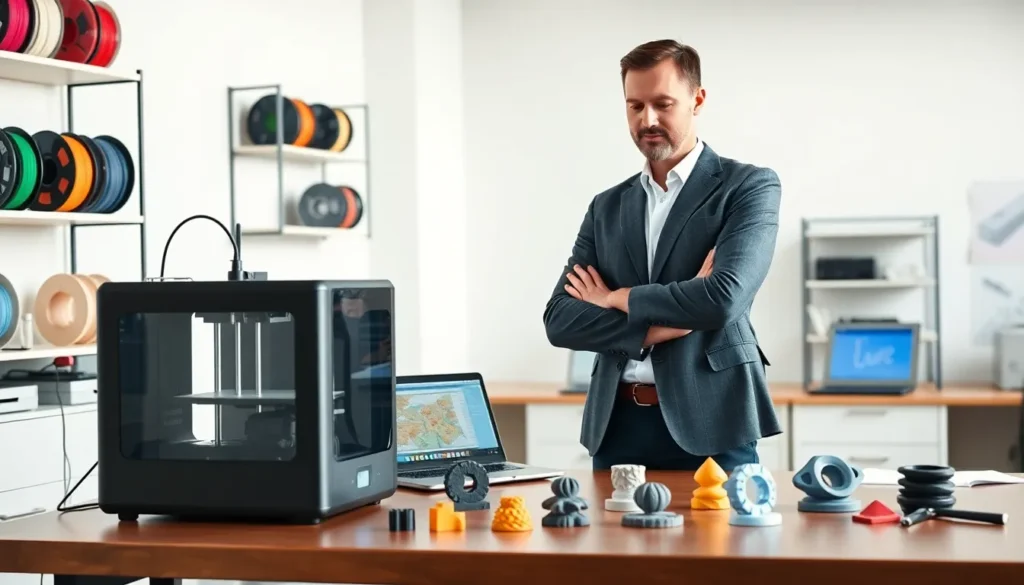

3D printing strategies can make the difference between a failed print and a professional-quality result. Whether someone prints prototypes, functional parts, or creative projects, the right approach saves time, money, and frustration.
Many beginners jump into 3D printing without a clear plan. They waste filament, deal with warped prints, and spend hours troubleshooting. Experienced makers know better. They follow proven 3D printing strategies that deliver consistent results.
This guide covers the essential techniques every 3D printing enthusiast should know. From material selection to post-processing, these strategies help users get more from their printers.
Table of Contents
ToggleKey Takeaways
- Effective 3D printing strategies start with matching the right material to your project—PLA for beginners, ABS for heat resistance, and PETG for versatile functional parts.
- Optimize layer height (0.2mm is a balanced default) and print speed to balance quality with production time.
- Design orientation matters: position critical stress points perpendicular to layer lines to maximize part strength.
- Use 40-60% infill with gyroid or cubic patterns to achieve strong, lightweight prints without wasting material.
- Post-processing techniques like sanding, priming, and epoxy coating transform good prints into professional-quality results.
- Applying proven 3D printing strategies saves time, reduces wasted filament, and delivers consistent, reliable prints.
Choosing the Right Materials for Your Projects
Material selection forms the foundation of successful 3D printing strategies. Each filament type has unique properties that affect print quality, durability, and appearance.
PLA (Polylactic Acid) remains the most popular choice for beginners. It prints at lower temperatures, doesn’t require a heated bed, and produces minimal warping. PLA works well for decorative items, prototypes, and low-stress parts.
ABS (Acrylonitrile Butadiene Styrene) offers greater strength and heat resistance. But, it requires higher print temperatures and an enclosed printer to prevent cracking. ABS suits functional parts that face mechanical stress or heat exposure.
PETG bridges the gap between PLA and ABS. It provides good strength, flexibility, and chemical resistance without the printing challenges of ABS. Many users consider PETG their go-to material for practical applications.
Specialty Materials Worth Considering
Beyond the basics, several specialty filaments expand what’s possible:
- TPU creates flexible, rubber-like parts for phone cases, gaskets, and wearables
- Nylon delivers exceptional durability for gears, hinges, and load-bearing components
- Carbon fiber composites add stiffness and reduce weight for performance parts
Smart 3D printing strategies match materials to project requirements. A decorative figurine doesn’t need expensive nylon. A functional bracket shouldn’t use brittle PLA. Consider the end use before selecting filament.
Optimizing Print Settings for Quality and Speed
Print settings directly impact both quality and production time. Fine-tuning these parameters represents one of the most effective 3D printing strategies available.
Layer height determines surface smoothness and print duration. Smaller layers (0.1mm) create smoother surfaces but take longer. Larger layers (0.3mm) print faster with visible stepping. Most users settle on 0.2mm as a balanced default.
Print speed affects detail accuracy and adhesion. Slower speeds (30-40mm/s) produce cleaner results on detailed models. Faster speeds (60-80mm/s) work fine for simple shapes and infill. Reducing speed for the first layer improves bed adhesion significantly.
Temperature tuning prevents many common problems. Too hot causes stringing and oozing. Too cold creates weak layer adhesion. Print a temperature tower to find the sweet spot for each filament brand.
Infill Strategies That Work
Infill percentage and pattern affect strength, weight, and print time:
- 10-20% infill suits decorative objects and display pieces
- 40-60% infill provides adequate strength for most functional parts
- 80-100% infill creates maximum strength for high-stress applications
Gyroid and cubic infill patterns offer better strength-to-weight ratios than standard grid patterns. These 3D printing strategies reduce material use while maintaining structural integrity.
Retraction settings also deserve attention. Proper retraction prevents stringing between parts. Start with 5mm retraction at 40mm/s for Bowden setups, or 1-2mm at 25mm/s for direct drive extruders.
Designing for Successful 3D Prints
Good design prevents printing failures before they happen. Several 3D printing strategies apply at the design stage.
Orientation matters more than most people realize. Parts printed vertically have weaker layer bonds along the Z-axis. Horizontal prints create stronger cross-sections but may need supports. Rotate models to position critical stress points perpendicular to layer lines.
Overhangs and bridges require careful consideration. Most printers handle overhangs up to 45 degrees without supports. Steeper angles need support structures or design modifications. Bridges span gaps between supported sections but struggle beyond 50-60mm.
Wall thickness affects printability and durability. Minimum wall thickness should exceed 1.2mm (three perimeter lines at standard settings). Thinner walls may not print solidly or might break under minimal force.
Design Tips That Save Time
- Add chamfers instead of sharp corners to reduce warping and improve adhesion
- Include a slight draft angle on vertical surfaces for easier support removal
- Design snap-fits with 0.2-0.3mm tolerance for proper engagement
- Split large models into smaller sections that print without supports
These 3D printing strategies transform problematic designs into reliable prints. A few minutes of design adjustment often saves hours of failed attempts and wasted material.
Post-Processing Techniques to Enhance Final Output
Post-processing turns good prints into great ones. These 3D printing strategies add professional polish to finished parts.
Support removal requires patience. Use flush cutters for thick supports and needle-nose pliers for smaller pieces. Warming PLA supports slightly makes them easier to snap off cleanly.
Sanding smooths visible layer lines. Start with 100-150 grit sandpaper to remove major imperfections. Progress through 220, 400, and 600 grit for increasingly smooth finishes. Wet sanding at higher grits prevents clogging and produces better results.
Chemical smoothing works on specific materials. Acetone vapor smooths ABS dramatically. Isopropyl alcohol helps with some specialty filaments. PLA doesn’t respond well to chemical smoothing, stick with mechanical methods.
Finishing Techniques for Professional Results
Priming and painting hide layer lines and add color. Spray filler primers fill small gaps and provide a paintable surface. Multiple thin coats beat single thick applications.
Heat treatment strengthens certain prints. Annealing PLA in an oven at 60-70°C increases crystallinity and heat resistance. The part may shrink slightly, so account for this in the original design.
Epoxy coating creates smooth, durable surfaces. Brush-on epoxy self-levels and fills layer lines. UV-curing resins work similarly and dry faster under UV light.
Effective 3D printing strategies don’t end when the printer stops. Post-processing separates amateur results from professional-quality output.