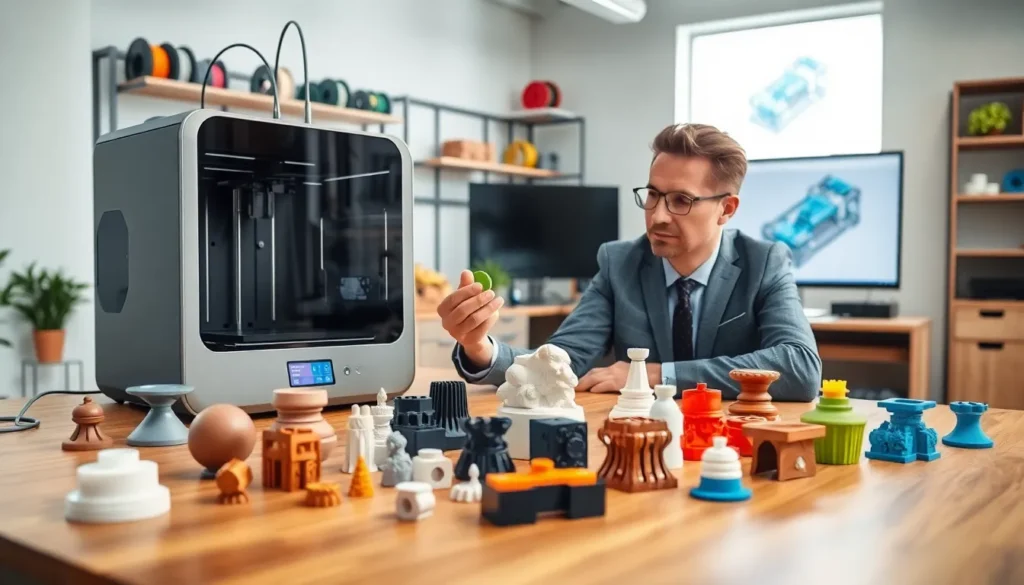

3D printing techniques have transformed how industries create everything from prototypes to finished products. Whether someone wants to build custom parts at home or produce industrial-grade components, understanding the different methods available is essential.
Each 3D printing technique offers distinct advantages. Some prioritize speed. Others deliver exceptional detail. A few handle materials that rival injection-molded plastics. This guide breaks down the most popular 3D printing techniques, explains how they work, and helps readers determine which method fits their specific needs.
Table of Contents
ToggleKey Takeaways
- FDM is the most accessible 3D printing technique, with printers starting under $200 and supporting a wide variety of materials.
- SLA and resin printing deliver superior detail and smooth finishes, making them ideal for jewelry, dental models, and miniatures.
- SLS produces the strongest plastic parts among 3D printing techniques and requires no support structures for complex geometries.
- Choose your 3D printing technique based on budget, material needs, detail requirements, and production volume.
- Many professionals combine multiple 3D printing techniques—using FDM for prototypes, SLA for detailed pieces, and SLS for end-use parts.
Fused Deposition Modeling (FDM)
Fused Deposition Modeling, commonly called FDM, is the most widely used 3D printing technique. It works by heating a thermoplastic filament and extruding it layer by layer through a nozzle. The material cools and hardens as each layer bonds to the one beneath it.
FDM printers accept various materials. PLA (polylactic acid) remains the most beginner-friendly option. ABS offers greater durability and heat resistance. PETG combines ease of use with improved strength. Specialty filaments infused with wood, carbon fiber, or metal particles expand creative possibilities further.
Advantages of FDM
- Low cost: FDM printers start under $200, making them accessible to hobbyists and small businesses.
- Material variety: Dozens of filament types exist for different applications.
- Large build volumes: Many FDM machines can print objects over 12 inches in any dimension.
- Simple maintenance: Replacing nozzles and clearing jams requires minimal technical skill.
Limitations of FDM
FDM prints show visible layer lines. Post-processing like sanding or chemical smoothing improves surface quality but adds time. Fine details under 0.5mm often print poorly. Overhangs beyond 45 degrees require support structures that leave marks when removed.
This 3D printing technique suits functional prototypes, mechanical parts, and large-scale models where surface finish matters less than structural integrity.
Stereolithography (SLA) and Resin Printing
Stereolithography, or SLA, uses ultraviolet light to cure liquid photopolymer resin into solid objects. A laser traces each layer’s cross-section, hardening the resin with extreme precision. MSLA (masked stereolithography) and DLP (digital light processing) variants use LCD screens or projectors instead of lasers but achieve similar results.
Resin 3D printing techniques produce parts with smooth surfaces and sharp details. Layer heights as fine as 0.025mm create nearly invisible layer lines. This makes SLA ideal for jewelry, dental models, miniatures, and any application requiring high resolution.
Advantages of SLA
- Superior detail: Resin printers capture features as small as 0.1mm.
- Smooth finishes: Parts often need no sanding before painting.
- Isotropic strength: UV-cured layers bond chemically, creating consistent strength in all directions.
- Fast layer times: MSLA printers cure entire layers simultaneously, speeding production.
Limitations of SLA
Resin costs more than FDM filament, typically $30 to $80 per liter. Uncured resin is toxic and requires careful handling with gloves and ventilation. Post-processing involves washing prints in isopropyl alcohol and additional UV curing. Build volumes tend to be smaller than FDM machines at comparable prices.
SLA remains one of the most popular 3D printing techniques for professionals who prioritize visual quality and dimensional accuracy over material costs.
Selective Laser Sintering (SLS)
Selective Laser Sintering uses a high-powered laser to fuse powdered material, usually nylon, into solid parts. The printer spreads a thin layer of powder across the build platform. The laser then sinters (heats without fully melting) specific areas according to the digital design. Fresh powder covers the sintered layer, and the process repeats.
SLS produces some of the strongest plastic parts among all 3D printing techniques. The surrounding powder supports each layer during printing, eliminating the need for dedicated support structures. This allows complex geometries that other methods cannot achieve.
Advantages of SLS
- No support structures: Unsintered powder supports overhangs and internal features.
- Functional strength: Nylon SLS parts withstand significant mechanical stress.
- Design freedom: Interlocking pieces, internal channels, and lattice structures print without issue.
- Batch production: Multiple parts can nest within the powder bed, maximizing efficiency.
Limitations of SLS
SLS equipment costs significantly more than consumer FDM or SLA printers. Entry-level industrial units start around $10,000, with professional systems exceeding $100,000. The powder itself is expensive. Post-processing requires removing excess powder and often dyeing parts, since raw nylon prints appear white or gray.
Manufacturers and engineers favor this 3D printing technique for end-use parts, functional prototypes, and small production runs where injection molding isn’t practical.
How to Choose the Right 3D Printing Technique
Selecting among 3D printing techniques depends on several factors. Budget, material requirements, detail level, and intended use all influence the decision.
Budget Considerations
FDM offers the lowest entry point. A capable printer, filament, and basic tools cost under $300 total. SLA requires a larger investment, around $300 to $500 for the printer plus ongoing resin and consumable costs. SLS remains primarily an industrial option unless users access shared services through online printing bureaus.
Material Needs
Does the part need heat resistance? ABS or high-temperature resins work well. Flexibility? TPU filament or flexible resins provide elasticity. Maximum strength? Nylon SLS parts outperform most alternatives. Matching material properties to application requirements narrows the options quickly.
Detail Requirements
Miniatures, jewelry, and dental applications demand SLA’s fine resolution. Mechanical parts and functional prototypes often don’t need that level of detail, FDM serves them adequately at lower cost.
Production Volume
Single prototypes favor FDM’s speed and simplicity. Small batches of detailed items suit SLA. Larger production runs benefit from SLS’s nesting capability or outsourcing to professional services.
Many makers and businesses use multiple 3D printing techniques. They choose FDM for quick iterations, SLA for display pieces, and SLS services for final production parts. This approach leverages each method’s strengths.