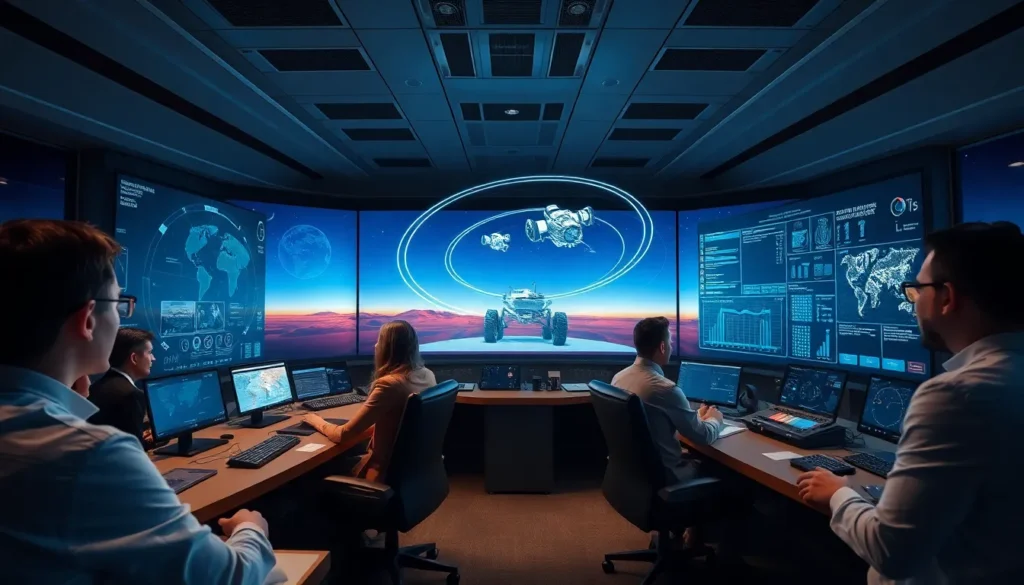

Space technology tools have transformed how humans explore the universe. From satellites orbiting Earth to rovers rolling across Mars, these tools make modern space missions possible. Engineers and scientists rely on specialized equipment to gather data, communicate across vast distances, and keep astronauts alive in hostile environments.
The space industry has grown rapidly over the past decade. Private companies and government agencies now launch more missions than ever before. Each mission depends on advanced space technology tools designed for specific purposes. These include communication systems, imaging devices, life support equipment, and robotic explorers.
This article examines the essential space technology tools that power today’s exploration efforts. It covers satellite systems, robotic equipment, astronaut support gear, imaging technology, and emerging innovations. Understanding these tools reveals how humans continue to push the boundaries of space exploration.
Table of Contents
ToggleKey Takeaways
- Space technology tools include satellites, robotic explorers, life support systems, and imaging devices that make modern space missions possible.
- Communication satellites and the Deep Space Network ensure constant contact with spacecraft across millions of miles.
- Advanced rovers like Perseverance use robotic arms, AI systems, and nuclear power to conduct experiments on Mars autonomously.
- Life support systems on the ISS recycle air and water, allowing astronauts to survive in hostile space environments.
- Imaging tools like the James Webb Space Telescope capture data across the electromagnetic spectrum to reveal details invisible to human eyes.
- Emerging innovations such as 3D printing, electric propulsion, and AI-driven systems are reshaping the future of space exploration.
Satellite Systems and Communication Tools
Satellites form the backbone of modern space technology tools. They orbit Earth and other celestial bodies to perform critical functions. Communication satellites relay signals across continents. Weather satellites track storms and climate patterns. Navigation satellites guide ships, planes, and cars with GPS technology.
Communication tools in space face unique challenges. Signals must travel millions of miles through the vacuum of space. Engineers use high-gain antennas to focus radio waves into tight beams. The Deep Space Network, operated by NASA, uses three ground stations positioned around Earth. This arrangement ensures constant contact with spacecraft throughout the solar system.
Modern satellites carry increasingly sophisticated payloads. Starlink satellites, for example, create a mesh network in low Earth orbit. They provide internet access to remote areas worldwide. Each satellite weighs about 570 pounds and contains phased array antennas, ion thrusters, and solar panels.
Space technology tools for communication also include transponders and signal amplifiers. Transponders receive signals from Earth, amplify them, and retransmit them on different frequencies. This process allows a single satellite to handle thousands of phone calls or television channels simultaneously.
Relay satellites serve as middlemen between spacecraft and ground stations. NASA’s Tracking and Data Relay Satellite System provides nearly continuous communication coverage. These space technology tools eliminate communication blackouts that occur when spacecraft pass behind Earth.
Robotic Exploration Equipment
Robots go where humans cannot. They explore planets, moons, and asteroids without risking human lives. Space technology tools for robotic exploration include rovers, landers, and flyby spacecraft.
Mars rovers represent some of the most advanced robotic explorers ever built. The Perseverance rover, which landed in 2021, carries 23 cameras, two microphones, and a drill for collecting rock samples. It weighs 2,260 pounds and runs on a nuclear power source called a radioisotope thermoelectric generator.
Robotic arms extend the reach of these machines. Perseverance uses a 7-foot robotic arm equipped with scientific instruments. The arm can grind rocks, take microscopic images, and analyze chemical compositions. These space technology tools allow scientists on Earth to conduct experiments 140 million miles away.
Orbital robots perform maintenance and assembly tasks. The International Space Station uses the Canadarm2, a 57-foot robotic arm that moves cargo, assists spacewalks, and captures visiting spacecraft. Dextre, a smaller two-armed robot, handles delicate repair work.
Sample return missions require specialized space technology tools. Japan’s Hayabusa2 collected material from asteroid Ryugu and returned it to Earth in 2020. The spacecraft used an impactor to create a crater, then collected ejected material with a sampling horn.
Autonomy plays an increasing role in robotic exploration. Light takes up to 22 minutes to travel between Earth and Mars. Rovers must make some decisions independently using onboard computers and AI systems. These space technology tools help robots avoid hazards and optimize their scientific work.
Life Support and Astronaut Tools
Keeping humans alive in space requires sophisticated life support systems. These space technology tools manage air, water, temperature, and waste aboard spacecraft and space stations.
The Environmental Control and Life Support System on the International Space Station recycles almost everything. It converts carbon dioxide back into oxygen through electrolysis. It processes urine and sweat into drinking water. A single system component, the Oxygen Generation Assembly, produces enough oxygen for six crew members.
Spacesuits represent self-contained life support systems. NASA’s Extravehicular Mobility Unit weighs about 280 pounds on Earth. It provides oxygen, removes carbon dioxide, regulates temperature, and protects against micrometeorites. Astronauts can spend up to eight hours outside the spacecraft in these suits.
Space technology tools for astronauts include specialized hand tools adapted for use in microgravity. Ordinary wrenches would spin the astronaut instead of the bolt. Engineers designed pistol-grip tools with reaction arms that absorb torque. These tools connect to tethers that prevent them from floating away.
Food systems have evolved significantly since early missions. Modern space food comes in various forms: freeze-dried, thermostabilized, and irradiated. The ISS includes a food warmer and a water dispenser for rehydrating meals. Astronauts can now enjoy coffee, pizza, and even fresh vegetables grown in orbit.
Medical space technology tools address health challenges in microgravity. Bone density scanners monitor skeletal health. Ultrasound devices allow remote diagnosis guided by doctors on Earth. Exercise equipment, including treadmills and resistance machines, helps astronauts maintain muscle mass during long missions.
Imaging and Remote Sensing Technology
Imaging systems capture data that human eyes cannot see. These space technology tools reveal hidden details about planets, stars, and galaxies. They operate across the electromagnetic spectrum, from radio waves to gamma rays.
The James Webb Space Telescope launched in 2021 and now orbits a million miles from Earth. Its 21-foot gold-plated mirror collects infrared light from the earliest galaxies. Webb’s instruments can detect heat signatures from exoplanets and analyze their atmospheres for signs of life.
Remote sensing space technology tools study Earth from orbit. Landsat satellites have monitored Earth’s surface since 1972. They track deforestation, urban growth, and agricultural changes. Each satellite carries multispectral sensors that capture images in multiple wavelengths simultaneously.
Radar systems see through clouds and darkness. Synthetic aperture radar creates detailed images by processing multiple radar pulses. These space technology tools measure ground movement with millimeter precision. Scientists use them to track volcanic activity, ice sheet changes, and earthquake damage.
Spectrometers identify materials by analyzing light. When light interacts with matter, it creates unique patterns called spectra. Space-based spectrometers have discovered water ice on the Moon, methane on Mars, and organic molecules on distant comets.
Gravity mapping tools reveal what lies beneath planetary surfaces. The GRACE satellites, which orbited Earth until 2017, measured tiny variations in Earth’s gravitational field. These variations indicated changes in groundwater, ice mass, and ocean currents. Similar space technology tools now study the Moon and Mars.
Emerging Innovations in Space Technology
New space technology tools emerge constantly as engineers push technical boundaries. Several innovations promise to reshape space exploration in the coming decades.
3D printing in space reduces dependence on Earth-based manufacturing. The ISS already uses a 3D printer to create replacement parts on demand. Future missions could print tools, habitats, and even food. NASA’s Redwire Regolith Print project aims to use lunar soil as printing material.
Electric propulsion systems offer higher efficiency than chemical rockets. Ion engines accelerate charged particles to generate thrust. They produce less force than traditional engines but can operate for months or years. NASA’s Dawn spacecraft used ion propulsion to visit two asteroids.
In-space refueling extends mission lifespans. Several companies are developing orbital fuel depots where spacecraft can top off their tanks. These space technology tools could make trips to Mars cheaper and more practical.
Artificial intelligence transforms how spacecraft operate. Machine learning algorithms help satellites identify cloud-free images automatically. AI systems plan rover routes and prioritize scientific targets. Future space technology tools will rely even more heavily on autonomous decision-making.
Advanced materials enable new capabilities. Carbon fiber composites reduce spacecraft weight. Shape-memory alloys create deployable structures that unfold in orbit. Heat shields made from reinforced carbon-carbon protect spacecraft during atmospheric entry.
Quantum communication represents the next frontier in space technology tools. China’s Micius satellite demonstrated quantum key distribution in 2017. This technology could enable unhackable communication between Earth and spacecraft across the solar system.