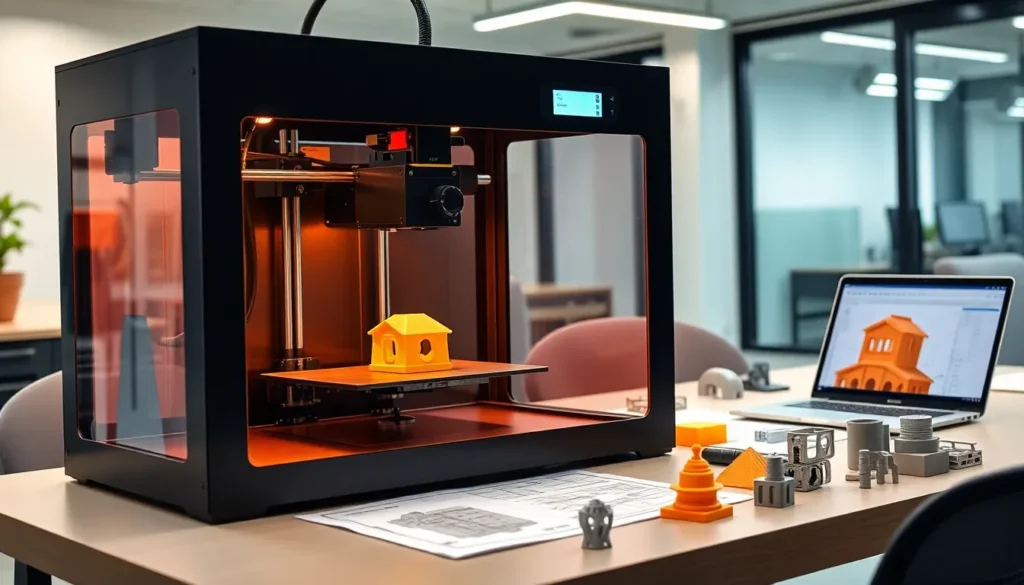

What is 3D printing? It’s a manufacturing process that creates physical objects from digital designs. A 3D printer builds items layer by layer, adding material until the final shape forms. This technology has changed how industries produce everything from medical implants to aerospace parts. Hobbyists use it to make custom toys and home repairs. Engineers rely on it for rapid prototyping. The applications keep expanding as 3D printing becomes more accessible and affordable. This article explains how 3D printing works, the main types of technology available, popular uses, and the key benefits and limitations users should know.
Table of Contents
ToggleKey Takeaways
- 3D printing is an additive manufacturing process that builds physical objects layer by layer from digital designs.
- FDM, SLA, SLS, and metal 3D printing are the main technologies, each suited for different materials and applications.
- Industries like healthcare, aerospace, and automotive use 3D printing for prototyping, custom parts, and lightweight components.
- Key benefits include design freedom, rapid iteration, low-volume cost savings, and reduced material waste.
- Limitations of 3D printing include slower speeds than mass production, material constraints, and visible layer lines requiring post-processing.
- As 3D printing becomes more affordable, applications continue expanding from professional manufacturing to home hobbyist projects.
How 3D Printing Works
3D printing follows an additive manufacturing process. Instead of cutting material away like traditional methods, it adds material in thin layers to build an object from the ground up.
The process starts with a digital 3D model. Designers create these files using CAD (computer-aided design) software or download existing designs from online libraries. The software then “slices” the model into hundreds or thousands of horizontal layers.
Once sliced, the file goes to the 3D printer. The machine reads each layer’s instructions and deposits material accordingly. Depending on the technology, this material might be melted plastic filament, liquid resin, or metal powder.
Each layer bonds to the one below it. The printer head or laser moves precisely, following the digital blueprint. Layer by layer, the object takes shape. A small item might take an hour. Larger, more detailed prints can run for days.
After printing completes, most objects need post-processing. This could mean removing support structures, sanding rough surfaces, or curing resin under UV light. The specific steps depend on the 3D printing technology and material used.
The basic workflow stays consistent across all 3D printing methods: design, slice, print, and finish. What changes is the type of material and the way the printer deposits or solidifies it.
Common Types of 3D Printing Technology
Several 3D printing technologies exist today. Each serves different purposes and works with different materials.
FDM (Fused Deposition Modeling)
FDM is the most common type of 3D printing for consumers and hobbyists. The printer heats plastic filament and pushes it through a nozzle. The nozzle moves along a set path, depositing thin lines of melted plastic that cool and harden. Popular materials include PLA, ABS, and PETG.
FDM printers are affordable and easy to use. They produce functional parts but leave visible layer lines on finished objects.
SLA (Stereolithography)
SLA uses a UV laser to cure liquid resin into solid plastic. The laser traces each layer’s shape in a vat of resin. After each layer cures, the build platform moves, and the process repeats.
SLA produces smooth, highly detailed prints. It’s popular for jewelry, dental models, and detailed miniatures. The trade-off is that resin costs more than filament, and prints require washing and additional UV curing.
SLS (Selective Laser Sintering)
SLS uses a laser to fuse powdered material, usually nylon or other polymers. The laser heats the powder just enough to bond particles together. Unfused powder supports the object during printing, so SLS doesn’t need support structures.
This 3D printing method creates strong, functional parts. It’s common in industrial settings for end-use products and complex geometries.
Metal 3D Printing
Metal 3D printing includes technologies like DMLS (Direct Metal Laser Sintering) and EBM (Electron Beam Melting). These methods fuse metal powder using lasers or electron beams.
Aerospace, automotive, and medical industries use metal 3D printing to produce lightweight, high-strength components. The equipment and materials carry high costs, limiting this technology to professional applications.
Popular Applications of 3D Printing
3D printing serves a wide range of industries and use cases. Its flexibility makes it valuable wherever custom or low-volume production matters.
Prototyping and Product Development
Engineers use 3D printing to create prototypes quickly. Instead of waiting weeks for tooling, teams can print functional models in hours. This speeds up design iteration and reduces development costs. Companies test fit, form, and function before committing to expensive manufacturing processes.
Healthcare and Medical Devices
The medical field has embraced 3D printing enthusiastically. Surgeons use patient-specific anatomical models to plan complex procedures. Dental labs print crowns, aligners, and surgical guides daily. Prosthetics manufacturers create custom-fitted limbs at a fraction of traditional costs.
Researchers are even exploring bioprinting, using 3D printing to create living tissue structures. While still experimental, this could eventually produce transplantable organs.
Aerospace and Automotive
Aerospace companies use 3D printing to manufacture lightweight brackets, fuel nozzles, and structural components. GE Aviation, for example, prints fuel nozzles for jet engines that are 25% lighter and five times more durable than traditionally made parts.
Automotive manufacturers print custom tooling, jigs, and low-volume parts. Some luxury and performance brands offer 3D-printed components as standard equipment.
Consumer Products and Hobbyists
Home users print replacement parts, custom phone cases, toys, and decorations. The maker community shares thousands of free designs online. Artists create sculptures and jewelry. Educators teach students design and engineering concepts through hands-on 3D printing projects.
Architecture and Construction
Architects print detailed scale models to present designs to clients. More ambitiously, some companies are developing large-scale 3D printing systems that can print entire buildings using concrete. Several 3D-printed homes already exist around the world.
Benefits and Limitations
3D printing offers clear advantages over traditional manufacturing in certain situations. It also has notable drawbacks users should understand.
Benefits
Design Freedom: 3D printing creates shapes impossible to manufacture with traditional methods. Internal channels, organic geometries, and complex assemblies print as single pieces.
Rapid Iteration: Changes happen fast. Modify a design file, print a new version, and test it the same day. Traditional manufacturing requires retooling that takes weeks.
Low-Volume Economics: For small batches and one-off items, 3D printing often costs less than injection molding or CNC machining. There’s no tooling investment.
Customization: Every print can differ without added cost. This makes 3D printing ideal for personalized products and patient-specific medical devices.
Reduced Waste: Additive manufacturing uses only the material needed for the part. Subtractive methods cut away and discard excess material.
Limitations
Speed: 3D printing is slow compared to mass production methods. Injection molding produces thousands of parts per hour. A single 3D print might take hours.
Material Constraints: While material options have expanded, 3D printing still can’t match the full range of properties available through traditional manufacturing.
Surface Finish: Most 3D prints show layer lines or require post-processing to achieve smooth surfaces. This adds time and labor.
Size Restrictions: Build volumes limit part size. Printing large objects requires sectioning and assembly or specialized large-format equipment.
Cost at Scale: For high-volume production, traditional manufacturing remains more cost-effective. 3D printing’s per-unit cost stays relatively constant regardless of quantity.